AI: The superpower of the century (Part 1)
- prernagoel0
- May 13
- 3 min read
For the last couple of years, AI has been continuously wowing us with the breakneck speed of its advancements. It is talked about in equal measures as a miracle that will solve everything, and as a menace which will cause untold disruption in the job market. We believe that the reality will be a little less dramatic, but no less pervasive.

The last few months have felt different
Even by “AI standards”, the pace of change recently has been absurd. New models, new products, new benchmarks, new agents, new demos – each week seems to arrive carrying another “this changes everything” headline like an overenthusiastic intern full of unrealistic ideas, trying to impress.
But underneath the hype, something real is happening. The quality of outputs is relentlessly improving, and not just in the theoretical, controlled lab-experiment sense. The latest systems are getting better at work that looks much closer to real economic activity: writing, coding, analysis, planning, customer communication, contract review, research and reporting.
The conversation is shifting – we are no longer impressed by well-choreographed demos. We are asking whether AI can indeed do useful work at a level that is comparable to a capable professional, at least for some categories of tasks.
Anthropic has shaken things up
One of the forerunners in this shift is Anthropic. The company has built real momentum by releasing products that are not just clever, but eminently usable. Claude has increasingly become associated with thoughtful writing, accurate research, strong reasoning, and effective coding workflows. It is getting serious attention from technology teams and professional services firms and has single-handedly crashed the market value of traditional SaaS companies.
There is also a broader point here. The frontier race is no longer just about who has the flashiest model, setting performance benchmarks. It is about who can turn raw model capability into something businesses can actually use for daily work. That is why products such as Claude Cowork for workplace use, coding solutions, and legal-sector workflows matter so much: they make AI feel less like a science project and more like the smart colleague you always wished you had.
Why coding has become AI’s showcase event
LLMs seem to have taken the coding world by storm. That is not because coding is easy, but because coding combines two things that make AI applications unusually powerful. First, there is a creative element: you have to design logic, structure, flow and trade-offs. Second, there is a brutally clear feedback loop: the code either works or fails. In other words, the machine gets to be creative, but real-world performance is immediately testable.
That combination is gold. It means AI can generate an answer, test it, improve it, test it again, and keep going in tight loops. This has delivered AI coding performance at or above human expert levels as demonstrated by benchmarks such as HumanEval, SWE-Bench, and real-world coding tasks sets in GDPval.
But are other applications also similarly positioned? To effectively answer this question, it helps to stop talking about AI as one giant magic all-purpose black-box, and start talking about it as a set of capabilities.
A useful way to think about AI: capabilities
A capability-based framing is a familiar tool for business leaders. It steers the conversation away from theatre and towards meaningful choices. Can AI write well enough to draft a client update? Can it research well enough to prepare a first-pass market scan? Can it code well enough to accelerate product development? Can it summarise meetings, generate videos, analyse numbers, review contracts, or support customer conversations at a useful level?
The table below is our view of the current capabilities of AI and a few example tools.
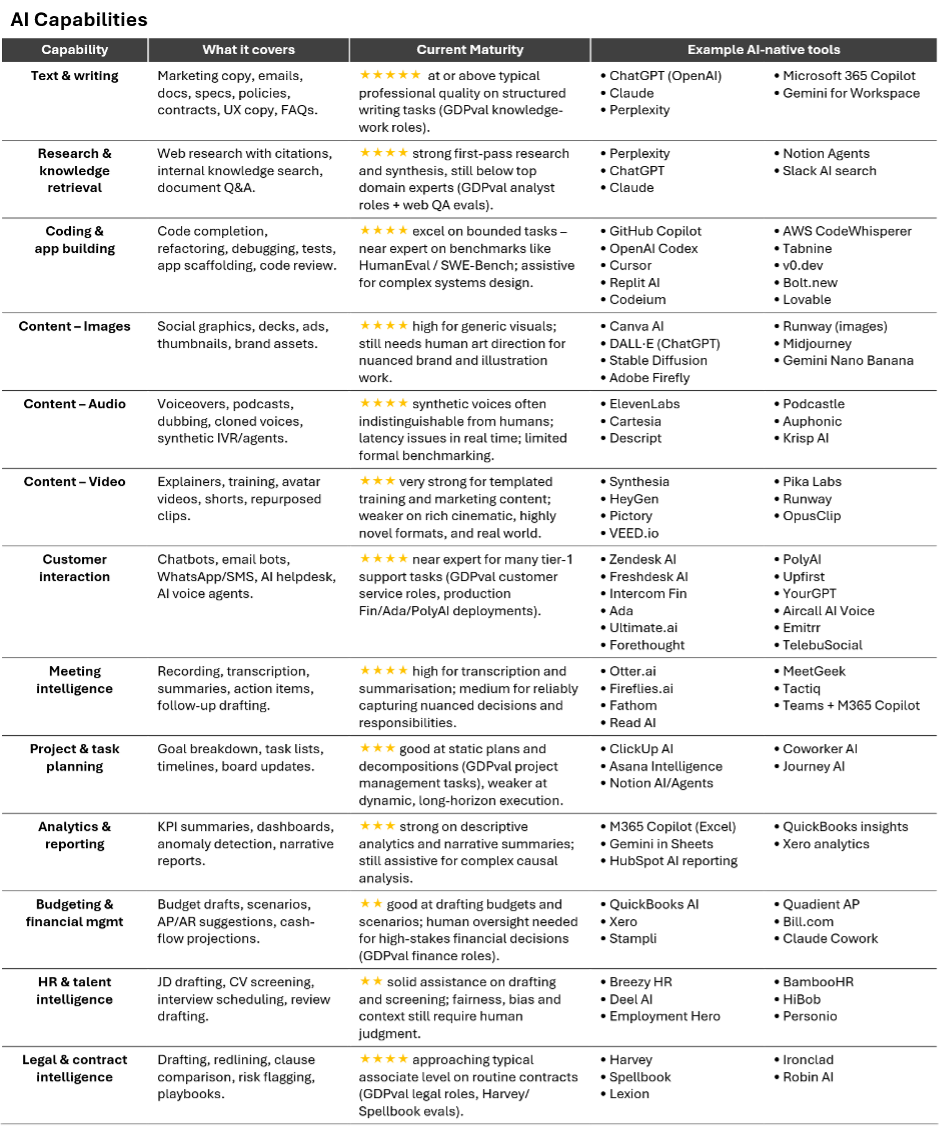
Source: Rygur research, company websites and news releases
When viewed this way, AI starts to look less like a single product and more like a cabinet full of superpowers. Some are already reliable. Some are impressive but messy. Some are still best kept under adult supervision.
So which superpower do you actually need?
This is the real question for leaders.
Do you need x-ray vision – the ability to see through a mountain of data and spot what matters? Do you need super-speed – drafting proposals, plans and reports in minutes instead of days? Do you need a tireless sidekick for research, coding or customer queries?
It is critical for businesses not to chase shiny AI demos but think it terms of capabilities they can actually make use of, to solve the pressing problems of today. In our next post, we will look at how businesses should go about doing this.


Comments